

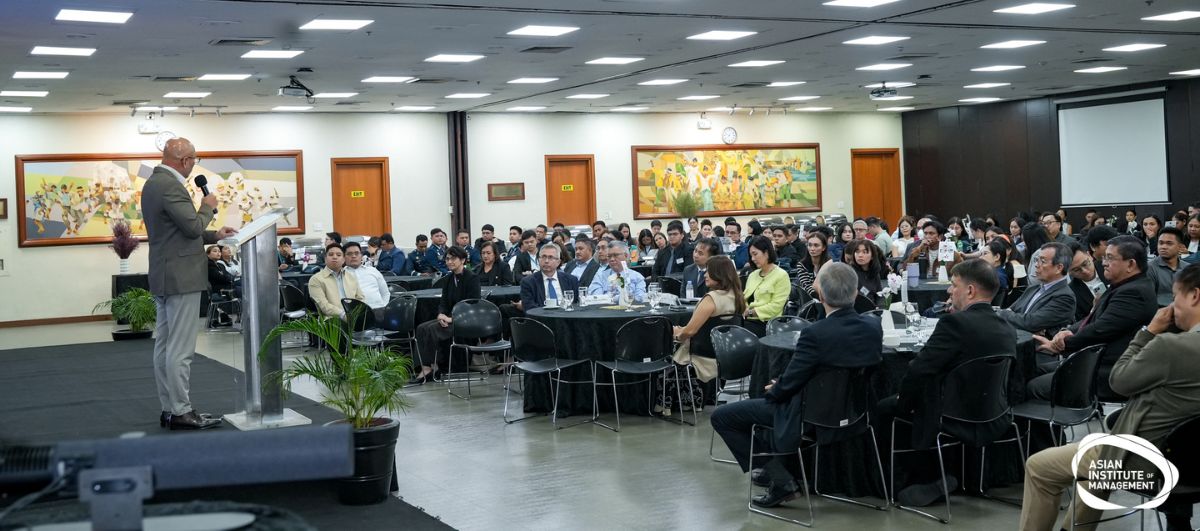
Sun Life of Canada Philippines, Inc. President Jonathan Juan “JJ” Moreno was the keynote speaker at the recent Asian Institute of Management (AIM) Convocation to welcome the incoming cohorts of the Online MBA (OMBA), Executive MBA (EMBA), Master in Innovation and Business (MIB), Executive Master in Cybersecurity Management (EMCSM), and Executive Master in Disaster Risk and Crisis Management (EMDRCM).
A graduate of AIM’s Master in Business Management (MBM) program in 2000, JJ recounted his interesting story as an AIM student. He spoke candidly about his early self-doubt regarding his suitability for the program, describing how his wife provided the encouragement to keep “showing up” until he gradually built confidence and mastered his courses, ultimately making the dean’s list and being elected president of his section.
Guided by a strong sense of patriotism and deep love for God and family, JJ stayed true to his values as he steadily moved up the corporate ladder. He built a reputation as a principled leader, always striving to leave a positive impact on the people and companies he worked with. And now, at the height of his career, JJ generously shared his life and career lessons with the incoming students through his heartfelt and deeply inspiring speech.
Read on and be inspired.
AIM Convocation Address
JJ Moreno
President, Sun Life of Canada Philippines Inc.
September 15, 2025
Good evening, everyone, AIM President and Dean Jikyeong Kang, distinguished members of the leadership team, faculty, honored guests, and above all, our new cohorts of AIM — the EMBA, OMBA, EMCSM, ME, MIB, and EMDRCM programs.
I would also like to acknowledge the presence of my wife, Chams, who, up to now, does not know why I brought her here tonight. This is actually the first time I have ever brought her to any business event where I was a speaker. I will explain in a few minutes why.
It is truly a privilege for me to be here, not only as President of Sun Life of Canada Philippines, but as a proud alumnus of the Master in Business Management Class of 2000.
It is indeed also a great honor to welcome you all as you embark on one of the most challenging and transformative journeys of your life. Congratulations on passing the rigorous selection process. But let me tell you this, getting in was the easy part. The real adventure—and the real test—begins today.
Before I proceed, allow me to share something very personal.
When I first entered AIM, I had no idea what to expect. To be honest, I only learned what an MBA was about two years before applying. To me, “MBA” sounded like a basketball league. (As a military officer, I really had no business background)
Not surprisingly, my very first day in AIM… was traumatic. Our first subject was an 8 am class on “The Language of Business”. I read the cases and the prescribed reading, but I felt lost during the case discussion, and the professor was cold-calling students. My classmates seemed sharper, quicker, more confident, rattling off concepts I had never heard of—NPVs, cost of capital, IRR. At that time, IRR took on a different meaning; for me , IRR meant “I Really Regret” being here. I thought: “Maybe I’m not cut out for this.”
I remember as I was driving back to my quarters in Camp Aguinaldo that day, I rehearsed how I would tell my wife about my decision to drop out. We did not have enough tuition money, I had a thriving military career, and there was a standing order back then from J1, GHQ to recall military officers who were taking business courses (The Deputy Chief of Staff for Personnel, J1, then said that “a military officer has no business in a business school).
So, when I told her about my plan, all she did was give me her reassuring smile and said: “Show up tomorrow, you can do this.”. That was one of the rare times when she did not support my decision (and I’m glad she didn’t).
That was it. Show up. And because I showed up, one day at a time, I eventually found my footing. I managed to fund my MBA (I took a loan from the Ayala Foundation & my wife took a salary loan from Pag-IBIG, we used our savings, etc.), made it to the dean’s list, was elected president of my section, and even qualified for an exchange program, which enabled me to complete my MBA at Melbourne Business School in Australia.
So to you, our new cohorts, let me begin with this: the journey ahead will not always be smooth. There will be days when you will feel out of place, overwhelmed, or even defeated. But leadership—real leadership—begins with “showing up.” Even when you’re unsure. Even when it’s hard. Especially when it’s hard. Just show up! Oh, and by the way, it pays to listen to your wife, too!
Student Life at AIM
I realized that it had been 27 years since I started my journey at AIM. Allow me to share some of my experiences to give you a glimpse of what student life at AIM will be like. I’m sure, though, that things will be a bit different now (people were still using beepers then, and SMS was just introduced by telcos that year).
Anyway, there will be nights when you’ll stay up until 3 a.m. working on a case, only to realize your analysis was based on the wrong exchange rate or incorrect project IRR (yes, I eventually figured out what IRR really meant).
There will be groupmates who show up with brilliant insights… and others who show up mainly with brilliant excuses.
You’ll learn that “cold calling” has nothing to do with sales—it’s that heart-stopping moment when a professor calls your name, and you wish the floor would open up and swallow you whole.
You’ll experience the joy of finishing a case discussion, only to be handed three more cases for the next day. It’s like finishing a marathon, being handed water, and realizing it’s actually the starting line of another marathon.
But here’s the thing: those sleepless nights, those debates with your groupmates, those terrifying cold calls—they are all part of the crucible. They’re what sharpen you. They’re what prepare you for the chaos, complexity, and ambiguity of the real world.
But before I go any further with my stories, my tasks tonight have been set. And like a good soldier, I follow. I have been asked to share the following:
- My insights on effective leadership strategies and their application in today’s dynamic world;
- My first-hand experiences highlighting innovation and collaboration in generating value and fostering positive impact; and
- Key lessons throughout my career journey.
Here goes..
Leadership Insights
From my journey since AIM, I want to share with you three leadership insights that I believe are timeless, yet especially relevant in today’s dynamic, uncertain world.

1. Establish Your Anchors
Leadership begins with anchors—in my case, my anchors are my values and my purpose.
My core values have always been clear: love of God, love of family, and love of country. From these flow other values, such as integrity, hard work, and resilience. These are my non-negotiables as they define me as a person, as a manager, as a leader.
My purpose statement is also just as clear and very personal: I developed this more than 15 years ago and have stuck with it since that time. My purpose statement is: “To make people believe in themselves, and in their capacity to be instruments of positive change in their families, society, country, and their faith.”. Simply put, my purpose is to be a catalyst for positive change.
Anchors keep you steady when the waters are rough. In leadership, storms are inevitable—financial crises, regulatory changes, pandemics, or even just the daily grind of managing teams. Without anchors, leaders drift. With anchors, even when the storm rages, you know your true north. Sometimes, this comes at a cost. You may turn down opportunities, resist popular but unethical choices, or make decisions that are career-limiting in the short term. But they will always make your professional life more impactful and fulfilling.
I remember a time early in my corporate career when I was asked to “look the other way”. Saying “no” was difficult. It wasn’t the career-enhancing choice. But it was the right one. It was during the Christmas season when I told my wife that I would be quitting my job, and that I didn’t know where I was going next. I explained that I was doing this because I do not want to compromise on my principles. The kids were very young then, and we were a single-income family. It was a tough decision, but she supported me 100%. “You’ll find something better,” was all she said.
By God’s providence, I soon found a new job in an organization that shares values aligned with mine. Over time, that consistency—being anchored in my principles—became part of my professional reputation. This made me realize that Leaders who drift may rise fast but fall hard, but anchored leaders may take longer to climb, but when they do, they endure.
So my advice to you: define your anchors early, and hold onto them firmly. Without anchors, even the most powerful ship drifts
2. Understand the Logic of the Business
It sounds simple, but you’d be surprised how many managers skip this. Leadership is not just about inspiring vision statements or being good at presentations. You must understand what makes your business move—its revenue model, its cost structure, the levers for growth, the industry dynamics, customer behavior, and the enablers and inhibitors that shape tomorrow.
When I took on new leadership roles, I never assumed I understood the business just because I understood “management.” I sat with the frontline staff. I engaged customers. I asked naïve questions. And I listened more than I spoke. It is only when you truly understand the “logic of the business” that you can make decisions that resonate at every level of the organization.
This matters even more today. In the world of AI, fintech, cybersecurity, and digital disruption—the very fields many of you are entering—you cannot just skim the surface. You need to decode business models, understand ecosystems, and see not just the current value chain, but the evolving value network. Leaders who fail here end up as great storytellers but poor strategists. Leaders who master it shape industries
As I mentioned earlier, you’ll be given more cases than you think humanly possible. And yes, some nights you’ll think the professors are secretly running an experiment in human endurance. But each case is teaching you exactly this: to peel back the layers, to see the system, to grasp the business logic underneath the numbers.
Remember this: the leaders who succeed are not always the smartest in the room — they are the ones who take the time to deeply understand the logic of the business they lead.
3. Focus on Value Creation, Capture, and Allocation
This is about execution and inclusion.
Ideas are abundant. Execution is scarce. Strategy gets you applause in the boardroom; execution delivers results in the marketplace.
The world belongs to those who do, not those who only think or say. This is empirically proven. Studies show that companies with a structured and deliberate strategy execution system realize an “execution premium” of up to 27%.
It is for this reason that every time I sit in strategy discussions, I’ve always insisted: “Don’t just tell me the what. Show me the how.” Strategy must be biased toward execution. Only then can value truly be created.
But value creation isn’t enough. Leaders must also capture it sustainably and allocate it fairly—across shareholders, employees, customers, and society. Hoarding value may give short-term gains, but allocating value builds long-term institutions. Always leave something on the table for others.
I’ve seen this play out in practice. At Sun Life, when we grow the business, our mindset isn’t just “How much do we gain?” but “How can we —through financial inclusion, through protection, through wellness—help our clients achieve lifetime financial security and live healthier lives?” That’s when leadership shifts from being effective to being impactful.
Managers deliver numbers. Leaders deliver impact.

First-Hand Experiences in Collaboration and Innovation
Now, let me share three stories from my own career journey where collaboration and innovation were not just buzzwords, but lifelines.
1. Corporate Governance Reform.
My journey started with private sector development, working on corporate governance reform in the Philippines and across Asia. Imagine walking into rooms where entrenched interests are defending what are considered abusive related-party transactions as “business as usual.” Imagine trying to push governance reforms for state-owned enterprises in environments where accountability was often optional. It was a daunting challenge.
But it was also a lesson in collaboration. I had the opportunity to represent the Philippines and Asia in the drafting of both Asian and global governance standards. These weren’t theoretical exercises—they were heated debates where we had to balance cultural realities, economic structures, governance regimes, and political resistance. Collaboration wasn’t about agreeing on everything, but about finding common ground that could move the region forward.
Innovation was equally crucial. Introducing governance concepts into systems that were deeply entrenched required not just logic, but creativity. We had to frame reforms not as foreign impositions but as enablers of growth and trust. The Philippine Stock Exchange eventually adopted standards I had the privilege of authoring. I also had the opportunity of playing a key role in the drafting of Republic Act No. 10149, otherwise known as the “GOCC Governance Act of 2011”.
Looking back, I realized this wasn’t just about changing rules—it was about shaping the very foundation of trust in our markets.
2. Transforming Transport Payments with Beep.
Fast forward to my time with beep. Millions of commuters relied on cash and closed systems for daily transport. It was inefficient, inconvenient, and costly for society. Together with a leading global card scheme, we envisioned a pivot: moving from a closed-loop transport card to an open-loop system.
This was not easy. Transport and payments were two different universes—each with its own priorities, regulations, and technical standards. The default instinct was competition, not collaboration. But by working together, by recognizing complementary strengths, we unlocked a new era of transport payments in the Philippines.
The impact went beyond efficiency. It set the stage for the possibility of having millions of daily commuters—ordinary Filipinos who experience the indignity of commuting—to experience the convenience of having multiple technology-enabled transit payment options. That’s the power of collaboration and innovation. When industries come together, they don’t just solve problems; they elevate lives.
3. Expanding Financial Inclusion at Sun Life.
Today, at Sun Life, I carry the same mindset. Insurance may seem like a financial product, but at its heart, it’s about trust and protection. To extend this to more Filipinos, we realized we couldn’t just rely on traditional channels. We had to collaborate beyond our industry.
We are now exploring partnerships with companies in adjacent industries—telcos, fintechs, other financial institutions, etc.—not only to build new channels, but to advance financial inclusion and wellness. Collaboration here is not about diluting our identity, but about amplifying our mission.
Innovation, in this case, is not just about technology. It’s about reimagining how industries can converge to serve people better. And once again, I’ve seen how collaboration transforms not just a company, but an entire ecosystem.
Three Lessons
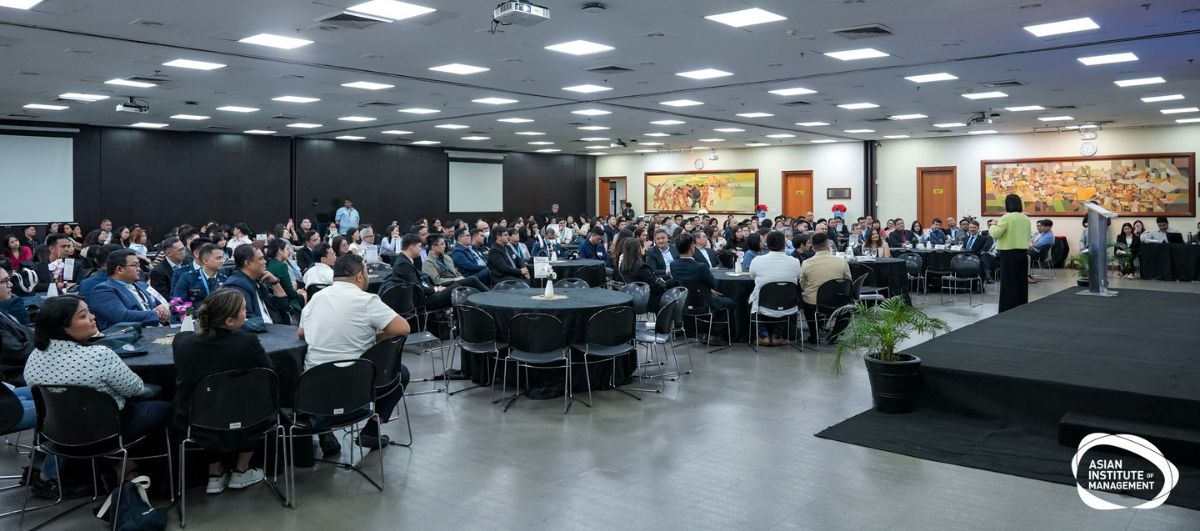
So, after anchors, insights, and my experiences in collaboration and innovation—what have I truly learned? Let me leave you with three lessons that I believe will serve you not just as managers or executives, but as leaders who will carry the AIM torch forward.
1. Be values-centered, execution-focused, and results-driven
Values are your compass, but execution is your sail, and results your port of call. Leadership is not about lofty intentions alone. It is about doing—consistently, excellently, and ethically.
Too often, I’ve seen brilliant strategies fail because the teams that crafted them were more enamored by the brilliance of the idea than by the discipline of execution. Remember: competitive advantage rarely comes from a strategy alone. It comes from how well you execute it, day after day. It’s like navigating at sea: charts and maps are essential, but it is the crew’s discipline, rhythm, and ability to follow through that actually brings the ship to its destination.
At Sun Life, we emphasize execution bias. We don’t just talk about growth—we operationalize it, measure it, and own it. The brilliance of strategy only matters if people feel its impact in real lives. And that is the call for you as AIM students and future leaders: anchor yourself in values, commit to disciplined execution, and never forget that results matter—not vanity metrics, but real, sustainable results that move institutions and uplift people.
2. Embrace transformation.
If there is one constant in today’s world, it is change. Technology, consumer behavior, geopolitics, climate realities—they are reshaping industries and societies faster than any of us could have imagined. To lead in this environment, you cannot just be a manager of the present; you must be an architect of the future.
When I worked on corporate governance reforms, transformation was about challenging entrenched practices. At beep, the transformation was about reimagining how two industries could converge to change how people commute.
At Sun Life, transformation means embracing new ideas and approaches, accelerating our digital transformation, expanding our reach to new markets and customer segments, all while staying true to our commitment to client-centricity and to our mission of financial inclusion and wellness.
But here’s the nuance: transformation is not just about technology or disruption. It is also about mindset. Leaders who cling to what worked yesterday often become irrelevant tomorrow. Leaders who embrace transformation—who anticipate, adapt, and even welcome it—remain relevant, even in storms. Be wary of the toxicity of success because what got you here will not necessarily get you to where you want to be.
For you, as AIM cohorts, embracing transformation means cultivating intellectual humility. It means realizing that what you learn here is not a static set of answers, but a foundation for lifelong reinvention.
3. Build institutions, and in doing so, build the nation.
Finally, leadership is not about you. It’s about what endures after you. Titles fade. Careers peak and wane. But institutions—strong, ethical, and resilient institutions—outlast us all.
When we worked on governance reforms, it wasn’t about individuals—it was about building systems of accountability that would benefit generations. At beep, it wasn’t just about a convenient card—it was about modernizing transport infrastructure that millions of Filipinos rely on daily. At Sun Life, it’s not just about market share—it’s about strengthening an institution that will continue protecting families long after my term ends.
And here is where your journey at AIM matters most. This institution has, for decades, shaped leaders who have gone on to build companies, reform governments, lead social enterprises, and yes, build nations. AIM’s mission is clear: to produce Asian leaders and managers who make a difference. You are about to be molded into that tradition.
Building institutions requires patience. It requires the discipline to think long-term in a world obsessed with short-term gains. It requires the courage to sometimes say “no” to shortcuts in order to build things that will stand. But when you do, you will discover that the highest calling of leadership is not personal success, but institutional legacy.
And to do all this—commit yourself to lifelong learning.
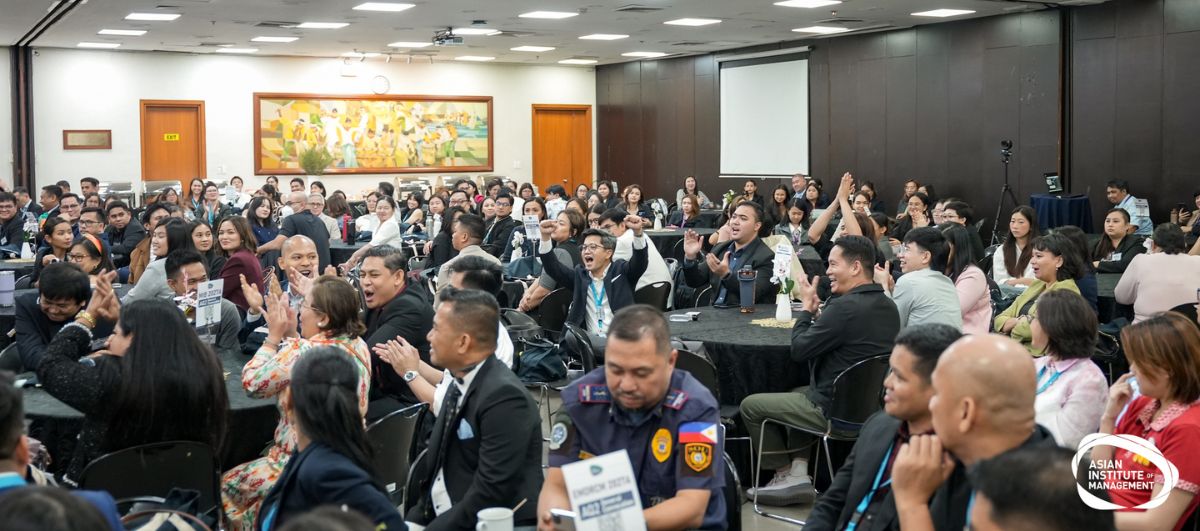
Because here’s the truth: whatever you learn here at AIM will be powerful, but it will not be enough. The world is moving too fast. Lifelong learning is no longer optional—it is the only way to stay relevant, resilient, and impactful.
In my own journey, I’ve seen how every season of life required me to learn again—sometimes unlearn what I thought I knew, and sometimes relearn with greater depth. From corporate governance to transport systems to financial services, I never stopped being a student. The moment you stop learning is the moment you start declining as a leader.
So, my charge to you is this: let this be not your final degree or program at AIM. Make this the launchpad for a lifetime of discovery, adaptation, and growth. Let this be the start of a lifelong partnership with AIM.
Closing Gratitude
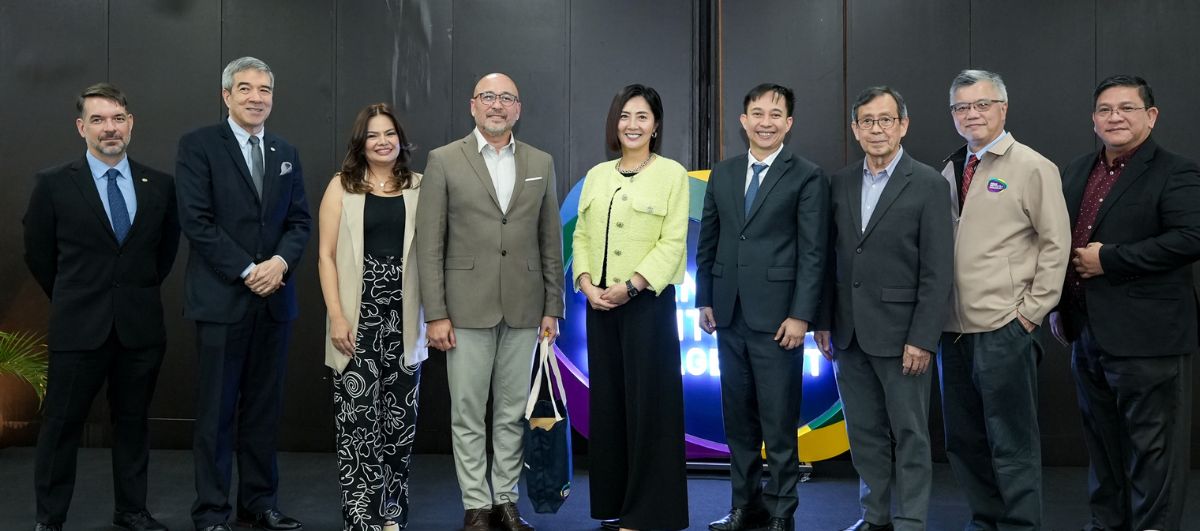
Finally, I want to thank AIM. This school molded me into what it calls “the Asian Manager”—globally minded, locally grounded, anchored in values, execution-focused, and committed to building nations.
To all of you, as you begin your AIM journey:
Show up. Even when it’s hard. Even when you doubt yourself. Because in showing up, again and again, you will discover not only the manager within you, but also the leader, the innovator, and the builder of nations you are meant to be. I do not doubt that one day, like me, you will stand here, grateful for the journey, grateful for AIM, and grateful for the people who stood beside you and gave you the strength to keep going.
Finally, to my wife: thank you for your quiet strength and unshakeable faith in me. On that first night at AIM, when I was ready to quit, you told me, “Show up tomorrow.” I listened—and it made all the difference.
Thank you, and welcome to AIM.


